
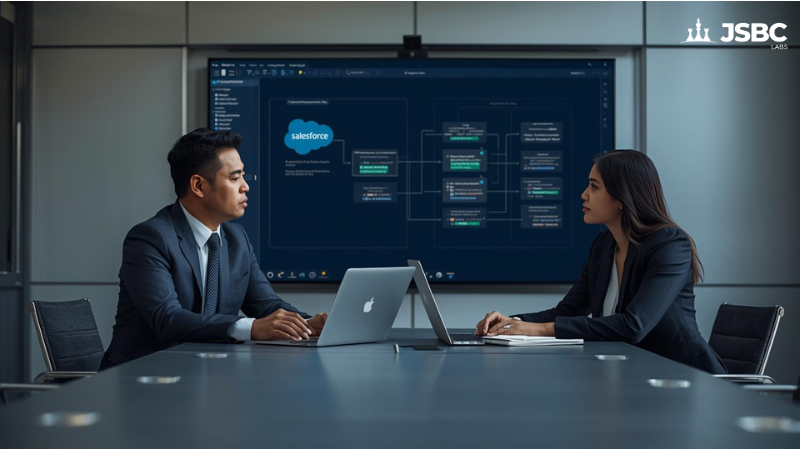
For many years, the role of the Salesforce professional was clearly defined.
Configure the platform. Build Flows. Deliver the system. Hand it over.
That model no longer holds.
As enterprise platforms mature and AI becomes embedded into core systems, Salesforce is no longer just a CRM. It is an operating layer — one that connects data, decision-making, compliance, and automation across the business.
And with that shift, the expectations placed on Salesforce professionals are changing rapidly.
From Configuration to Architecture
The industry has spent the last decade rewarding technical configuration.
Flows, objects, triggers, dashboards — all essential, all valuable.
But configuration alone does not answer today’s questions at leadership level:
- Where does our data come from, and can we trust it?
- How does information move across departments?
- Where are decisions being automated, and on what basis?
- What risk have we introduced without realising it?
- How does this system support where the business is going — not just where it is today?
These are architectural questions, not configuration ones.
The modern Salesforce professional is increasingly expected to understand data orchestration, governance, system boundaries, and business outcomes — not simply how to build within the platform.
AI Has Accelerated the Gap
This shift has been accelerated by AI.
By the end of this year, Gartner predicts that 40% of enterprise applications will include task-specific AI agents. These are not generic chatbots. They are systems making decisions, triggering actions, and operating at speed.
AI does not remove complexity.
It magnifies it.
If data is poorly structured, AI produces poor outcomes.
If governance is weak, AI introduces risk at scale.
If systems are disconnected, AI amplifies fragmentation instead of fixing it.
This has created a very real digital skills gap.
Many teams can implement tools.
Fewer can design systems that remain stable, governed, and understandable as intelligence is layered on top.
Why Handover-Driven Delivery Fails
Traditional delivery models assume that once a system is built, it can simply be “handed over” to the business.
In today’s environment, that is a risk.
Systems are no longer static. They evolve continuously.
AI models change. Business rules shift. Data sources expand. Regulatory pressure increases.
A clean handover without shared understanding often results in:
- Teams that rely heavily on external support
- Architecture decisions no one fully owns
- Fear of change because the system feels fragile
- Technology that becomes a constraint instead of an enabler
This is not a failure of people.
It is a failure of approach.
The Case for Shoulder-to-Shoulder Delivery
At JSBC Labs, we work differently.
We do not position ourselves as a vendor that disappears after implementation.
Nor do we aim to make clients dependent on us.
Our role is to act as a shoulder-to-shoulder partner — working alongside internal teams to co-engineer systems they understand, trust, and can confidently evolve.
That means:
- Designing architecture with long-term business goals in mind
- Making data flow and governance explicit, not implicit
- Ensuring AI and automation are introduced deliberately, not opportunistically
- Building capability inside the organisation, not just delivering artefacts
The goal is not simply a working system.
The goal is a technical foundation aligned to the business, with people who understand how and why it works.
Strategic Architecture Is the New Differentiator
The organisations that will succeed over the next decade are not those with the most tools.
They are the ones with:
- Clear system boundaries
- Trusted data
- Governed automation
- Technology that supports decision-making, not noise
- Teams that can adapt without fear of breaking everything
This is where the Salesforce role is heading — away from isolated configuration and toward strategic architecture.
And it is where delivery partners must evolve as well.
Looking Ahead
The future of enterprise technology will not be defined by who implements the fastest.
It will be defined by who builds systems that remain understandable, controllable, and valuable as complexity increases.
That requires a different mindset.
A different role.
And a different way of working together.
At JSBC Labs, that is the standard we build to.


