
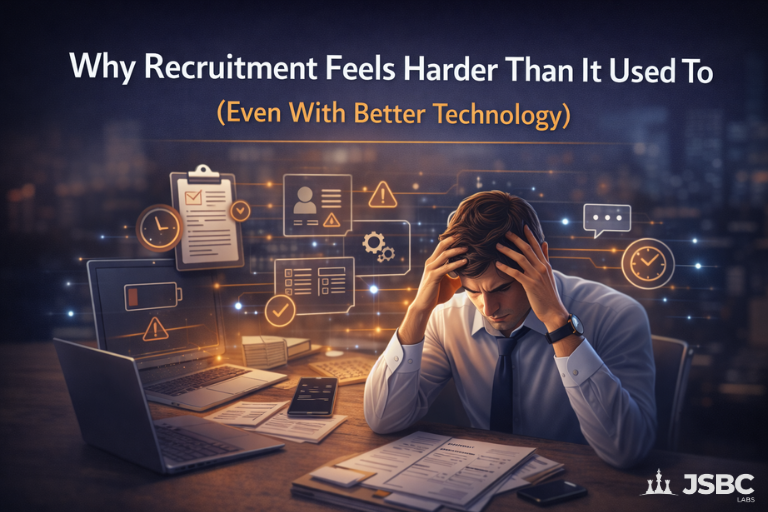
On paper, recruitment should be easier than ever.
There’s more technology, more data, more automation, and more tools designed to support recruiters at every stage of the process. Yet speak to almost any recruiter and you’ll hear the same thing:
“It feels harder than it used to.”
That feeling isn’t imagined, and it’s not because recruiters are doing a worse job.
Expectations have changed faster than the job itself
One of the biggest shifts in recruitment isn’t technology, it’s expectation.
Recruiters are now expected to:
- Move faster
- Be constantly available
- Deliver perfect candidate experiences
- Provide instant updates to clients
- Stay compliant without slowing down
What used to be seen as “good service” is now the baseline.
Anything less is noticed immediately.
Speed is assumed, not rewarded
Technology has raised expectations around speed to the point where it’s no longer acknowledged.
Fast shortlists, quick feedback loops, and immediate responses are assumed, not appreciated. When things go smoothly, it’s invisible. When they don’t, it’s a problem.
That constant pressure to maintain pace leaves very little margin for error, or recovery.
The role has expanded quietly
Recruitment today isn’t just recruitment.
Recruiters are also:
- Account managers
- Process coordinators
- Candidate support
- Data stewards
- Problem-solvers when things go wrong
Much of this work sits outside job descriptions and KPIs, but it takes real time and energy. Over time, that load accumulates.
Technology helps, but it doesn’t remove complexity
Recruitment technology has improved significantly. But technology doesn’t reduce complexity, it changes where it shows up.
More tools mean:
- More touchpoints
- More expectations of accuracy
- More visibility into mistakes
- Less room for “human error”
When everything is tracked, nothing feels small, even minor issues can feel amplified.
Why this pressure feels personal
When recruitment feels harder, it’s easy for recruiters to internalise it.
Missed calls, delayed feedback, unhappy candidates, even when caused by external factors, can feel like personal failures. Over time, that emotional load contributes to fatigue and frustration.
This isn’t a reflection of poor performance.
It’s a reflection of how demanding the role has become.
What actually makes recruitment feel sustainable
Recruitment feels manageable when:
- Expectations are realistic
- Processes support momentum rather than interrupt it
- Technology reduces friction instead of adding steps
- Recruiters aren’t carrying problems that sit outside their control
Sustainability in recruitment isn’t about working harder.
It’s about removing unnecessary pressure.
Recruitment hasn’t become harder because recruiters aren’t good enough, or because technology doesn’t work.
It feels harder because the role has expanded, expectations have intensified, and the margin for error has shrunk.
Recognising that reality is the first step toward building better support, for recruiters and the work they do every day.


