
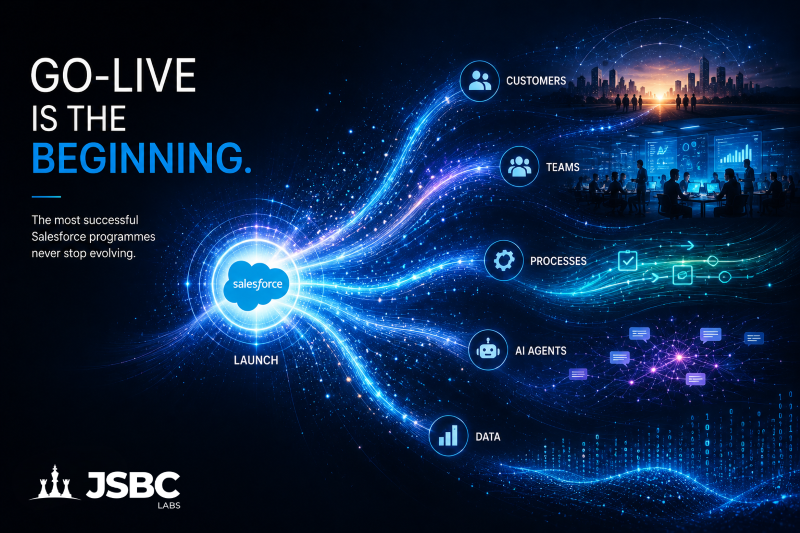
For years, organisations have approached Salesforce in the same way: define requirements, build a solution, go live, and move on to the next project.
It made sense when Salesforce was primarily a CRM. Businesses implemented it to solve a specific problem, delivered the project, and measured success based on whether it was completed on time and within budget.
But Salesforce isn’t just a CRM anymore.
Today, Salesforce sits at the centre of customer engagement, operations, service delivery, analytics, automation, AI, and increasingly, business strategy itself. The organisations seeing the greatest value from Salesforce are no longer treating it as a project. They’re treating it as a product.
The difference matters.
A project has a finish line. A product evolves continuously.
When businesses manage Salesforce as a project, the focus tends to be on delivery. Teams concentrate on requirements, timelines, and go-live dates. Once the implementation is complete, attention shifts elsewhere until the next major initiative demands investment.
The result is familiar. New business requirements emerge. Users develop workarounds. Processes evolve. Technology advances. Before long, the platform no longer reflects how the business actually operates.
A product mindset changes this dynamic entirely.
Instead of asking, “When will the project be finished?” organisations ask, “How do we continuously improve the platform to support our business goals?”
This approach creates a roadmap driven by business outcomes rather than project milestones. User feedback becomes a critical input. Adoption, efficiency, customer experience, and operational performance become ongoing measures of success. Enhancements are delivered incrementally, reducing risk while ensuring the platform continues to create value.
This shift is becoming even more important as organisations explore technologies such as Data Cloud, Agentforce, and AI-driven automation. These capabilities cannot simply be implemented and forgotten. They require governance, optimisation, and continuous refinement as business needs and technology evolve.
The companies gaining the most value from Salesforce aren’t necessarily spending more. They’re thinking differently. They recognise that digital transformation is not a one-time event, and neither is Salesforce.
The age of Salesforce projects is ending.
The future belongs to organisations that view Salesforce as a living product—one that evolves alongside the business, adapts to new opportunities, and continuously delivers measurable value.
The question is no longer whether your Salesforce project was successful.
The real question is whether your Salesforce platform is getting better every month.


