
When businesses invest in Salesforce, the expectation is usually simple:
Better processes.
Better visibility.
Better scalability.
Better operational efficiency.
And in many cases, Salesforce absolutely delivers on those expectations.
But there’s a hidden issue that often develops quietly over time inside growing Salesforce environments:
Technical debt.
Most businesses don’t notice it at first.
The platform still works.
Teams continue operating.
Automation continues running.
But behind the scenes, complexity begins building layer by layer — until the system becomes slower, harder to maintain, and increasingly difficult to scale.
What Is Salesforce Technical Debt?
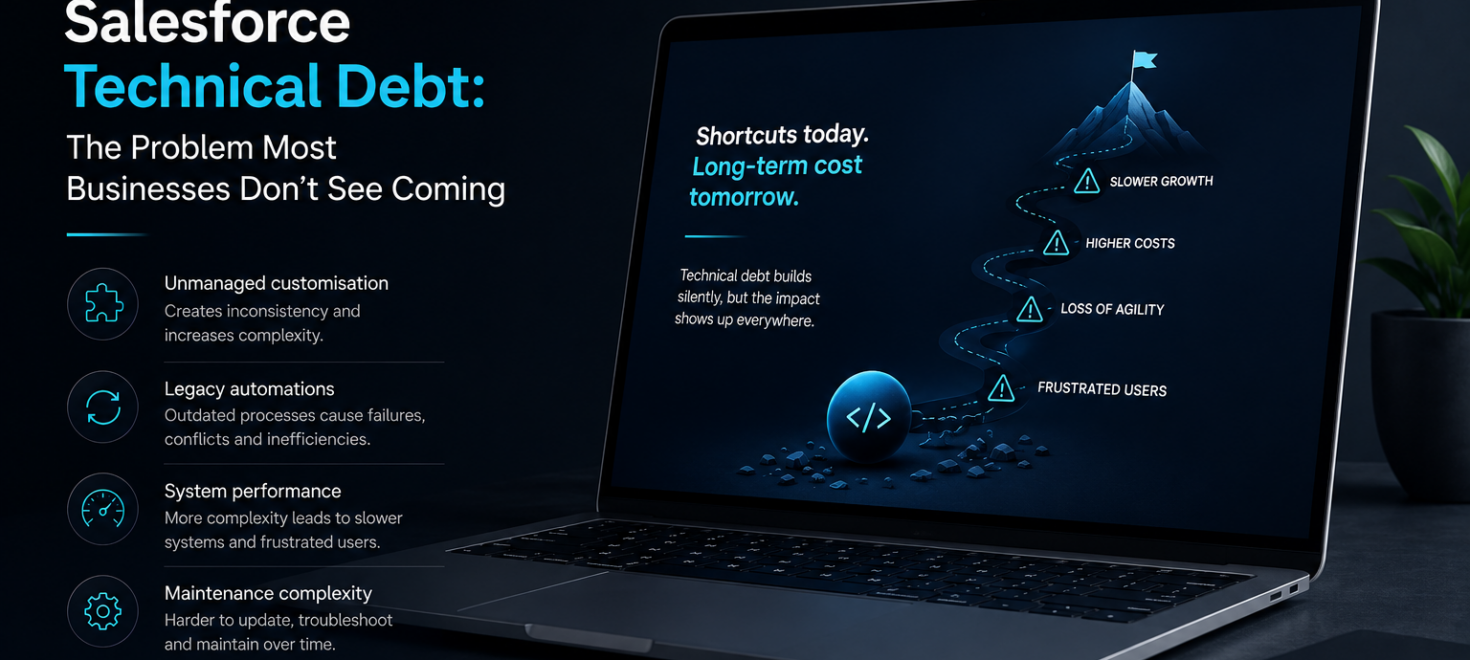
Technical debt refers to the long-term operational problems created by short-term implementation decisions.
In Salesforce environments, this often happens when businesses prioritise speed over structure during implementation or expansion.
Examples include:
- rushed customisations,
- poorly planned automation,
- inconsistent data structures,
- duplicated processes,
- unmanaged integrations,
- or temporary fixes that eventually become permanent.
Over time, these decisions accumulate and create operational friction across the entire platform.
Why Technical Debt Happens
Technical debt rarely comes from a single major mistake.
More often, it develops gradually.
A quick workaround is added to solve an urgent problem.
A new automation is layered onto an existing process.
Custom fields are created without governance.
Old workflows are never removed after upgrades.
Individually, these changes may seem harmless.
But as the system evolves, the environment becomes increasingly complex and difficult to manage.
This is especially common in fast-growing businesses where operational requirements change rapidly.
The Problem With Unmanaged Customisation
Salesforce is highly flexible, which makes customisation incredibly powerful.
But flexibility without governance often creates problems later.
Many businesses eventually end up with:
- duplicate fields,
- inconsistent naming conventions,
- overlapping functionality,
- conflicting automations,
- and custom processes nobody fully understands anymore.
The more unmanaged customisation exists, the harder the environment becomes to maintain and scale.
In some cases, businesses become hesitant to make changes at all because they fear breaking existing functionality.
Legacy Automations Become Operational Risks
Automation is designed to improve efficiency.
However, older automations that were never reviewed or redesigned often become major operational challenges.
Legacy workflows can create:
- duplicated actions,
- conflicting logic,
- reporting inconsistencies,
- performance slowdowns,
- and unpredictable system behaviour.
As businesses grow, these older automations often remain hidden inside the platform long after the original operational requirements have changed.
Eventually, the environment becomes difficult to troubleshoot and increasingly fragile.
System Performance Begins To Decline
One of the clearest signs of technical debt is declining system performance.
Overloaded automations, unnecessary customisation, excessive integrations, and poor data structures can impact:
- processing speed,
- reporting performance,
- user experience,
- and overall platform reliability.
Teams may begin noticing:
- slower page loads,
- delayed workflows,
- inconsistent reporting,
- or automation failures.
At that point, the issue is no longer just technical.
It becomes operational.
Maintenance Becomes Increasingly Complex
As technical debt grows, even small changes become more difficult.
Simple updates may require:
- testing across multiple workflows,
- reviewing outdated dependencies,
- checking overlapping automations,
- and troubleshooting unrelated system behaviour.
This slows down innovation and makes the platform harder to evolve alongside the business.
What should be a scalable operational system gradually becomes difficult to manage efficiently.
Rebuilding Becomes More Expensive Than Prevention
One of the biggest challenges with technical debt is that businesses often delay addressing it until major rebuilding becomes necessary.
Eventually, organisations reach a point where:
- workflows need redesigning,
- Automation needs consolidating,
- data structures require rebuilding,
- or entire operational processes must be re-engineered.
These rebuild projects are often far more expensive and disruptive than implementing proper governance and scalable architecture from the beginning.
Why Scalability Requires Long-Term Thinking
Salesforce environments should be designed with future growth in mind.
That means considering:
- maintainability,
- operational clarity,
- governance,
- scalability,
- and system simplicity from the start.
Short-term solutions may solve immediate business needs, but without structure, they often create larger operational challenges later.
Scalable systems are usually built through consistency, simplicity, and thoughtful architecture — not endless layers of complexity.
Final Thoughts
Salesforce technical debt is one of the most common operational problems businesses don’t recognise until it begins affecting performance, scalability, and day-to-day operations.
The issue rarely appears overnight.
It develops gradually through unmanaged growth, rushed implementations, legacy automations, and increasing complexity over time.
Businesses that prioritise clean architecture, scalable workflows, and long-term operational thinking are far more likely to build Salesforce environments that remain efficient, adaptable, and sustainable as they grow.


