
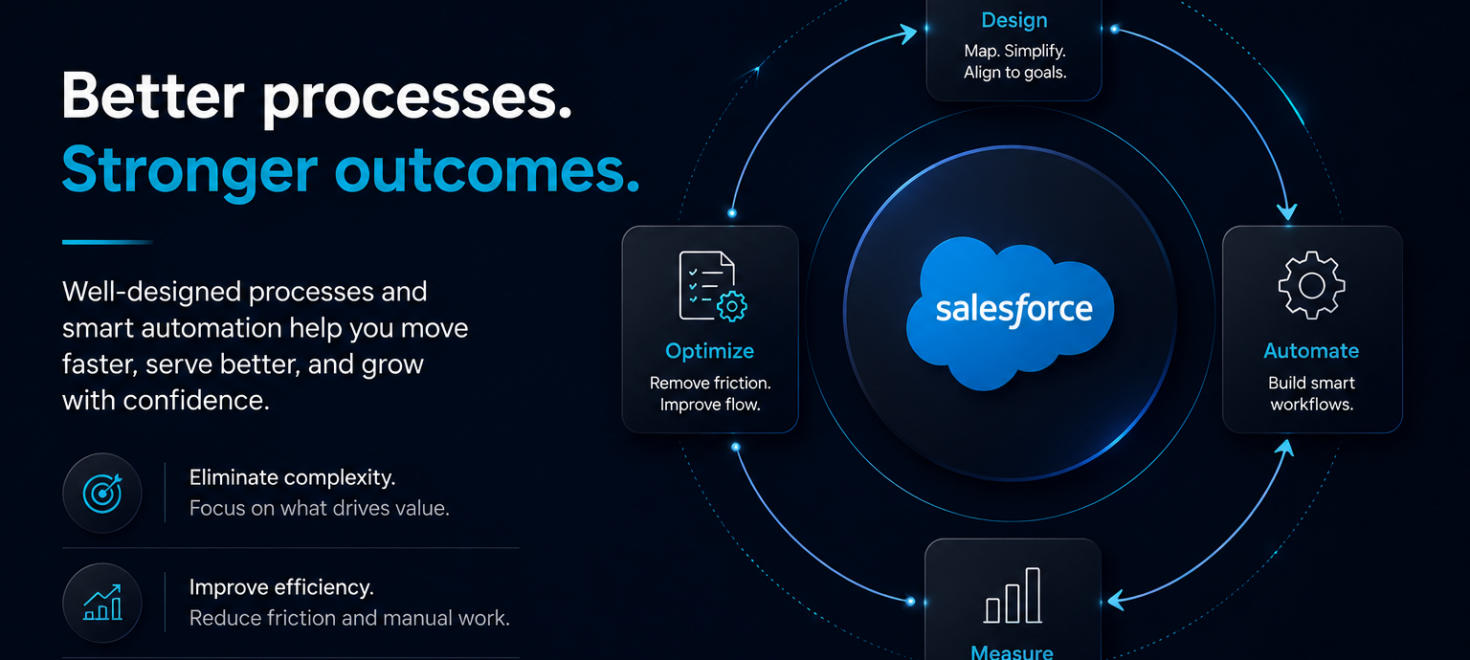
Automation has become one of the biggest priorities for modern businesses.
Companies want faster workflows, fewer manual tasks, improved efficiency, and better operational visibility. Platforms like Salesforce make that possible through automation, integrations, and digital workflow management.
But there’s a major issue many organisations overlook:
Automating a broken process does not improve it.
It simply allows the inefficiency to happen faster.
This is one of the biggest reasons many digital transformation projects fail to deliver long-term value.
The Problem With Automating Existing Processes
Many businesses approach automation with a very simple mindset:
“Take the current process and automate it.”
At first, this sounds logical.
But many operational processes already contain:
- unnecessary approvals,
- duplicated tasks,
- inconsistent workflows,
- communication gaps,
- manual workarounds,
- and outdated operational logic.
When these processes are automated without being redesigned first, businesses often end up creating systems that are:
- more complicated,
- harder to maintain,
- confusing for users,
- and difficult to scale.
Technology alone does not solve operational inefficiency.
Faster Workflows Are Not Always Better Workflows
A process can be fully automated and still perform poorly.
For example:
- an approval process with too many decision points,
- repetitive data capture across departments,
- unclear ownership between teams,
- disconnected reporting structures,
- or workflows that rely heavily on manual intervention.
Automation may reduce clicks and emails, but it does not address the underlying operational problem.
In many cases, poor workflows become even harder to identify once they are hidden behind automation.
Why Process Optimisation Matters
Before implementing automation, businesses need to evaluate how their operations actually function.
That means understanding:
- where bottlenecks exist,
- which steps create delays,
- where teams experience friction,
- and how information moves across the business.
Process optimisation focuses on simplifying operations before technology is layered on top.
The goal should be to create workflows that are:
- clear,
- efficient,
- scalable,
- and easy for teams to follow.
Only then does automation become truly effective.
Over-Automation Creates Complexity
One of the most common issues inside modern enterprise systems is over-automation.
Businesses often build:
- too many workflow rules,
- overlapping automations,
- conflicting logic,
- and processes that become difficult to understand over time.
What begins as an attempt to improve efficiency eventually creates:
- maintenance challenges,
- operational confusion,
- unreliable reporting,
- and slower system performance.
Complexity increases.
Agility decreases.
Sustainable systems are usually the ones designed with simplicity in mind.
Workflow Engineering Requires Strategic Thinking
Effective workflow design is not just a technical exercise.
It requires understanding:
- how teams collaborate,
- how departments interact,
- how decisions are made,
- and how operational goals align with technology.
The strongest operational systems are designed around business outcomes rather than software features alone.
That includes building workflows that:
- reduce friction,
- improve visibility,
- eliminate unnecessary steps,
- and support long-term scalability.
Why Digital Transformation Projects Often Fail
Many digital transformation initiatives focus heavily on technology implementation while overlooking operational design.
New platforms are introduced.
Automation is added.
Systems are integrated.
But the underlying business processes remain inefficient.
As a result, organisations often recreate existing operational problems inside newer, more advanced systems.
Without process clarity and operational alignment, even the most powerful technology platforms struggle to deliver meaningful results.
Simplicity Scales Better
As businesses grow, operational complexity naturally increases.
The systems that scale most effectively are usually the ones built around:
- simplicity,
- consistency,
- clear governance,
- and maintainable workflows.
Well-designed operational processes make automation easier, reporting more accurate, and user adoption significantly stronger.
The opposite is also true:
Complex workflows become harder to maintain as businesses evolve.
Final Thoughts
Automation is an incredibly powerful tool, but it is not a solution on its own.
Businesses that focus only on automating tasks without improving the underlying processes often create more operational complexity over time.
Successful digital transformation depends on combining technology with strong operational design, scalable workflow engineering, and process optimisation.
Because efficient systems are not built by automating everything.
They are built by understanding what should be improved first.


