
For years, businesses approached CRM systems with a fairly simple mindset:
Implement one platform, standardise processes, and use the same structure across every department and workflow.
But modern businesses are no longer operating in generic environments.
Industries have become more specialised.
Customer expectations have evolved.
Operational complexity has increased.
And businesses now require systems that support the way their industries actually work, not the other way around.
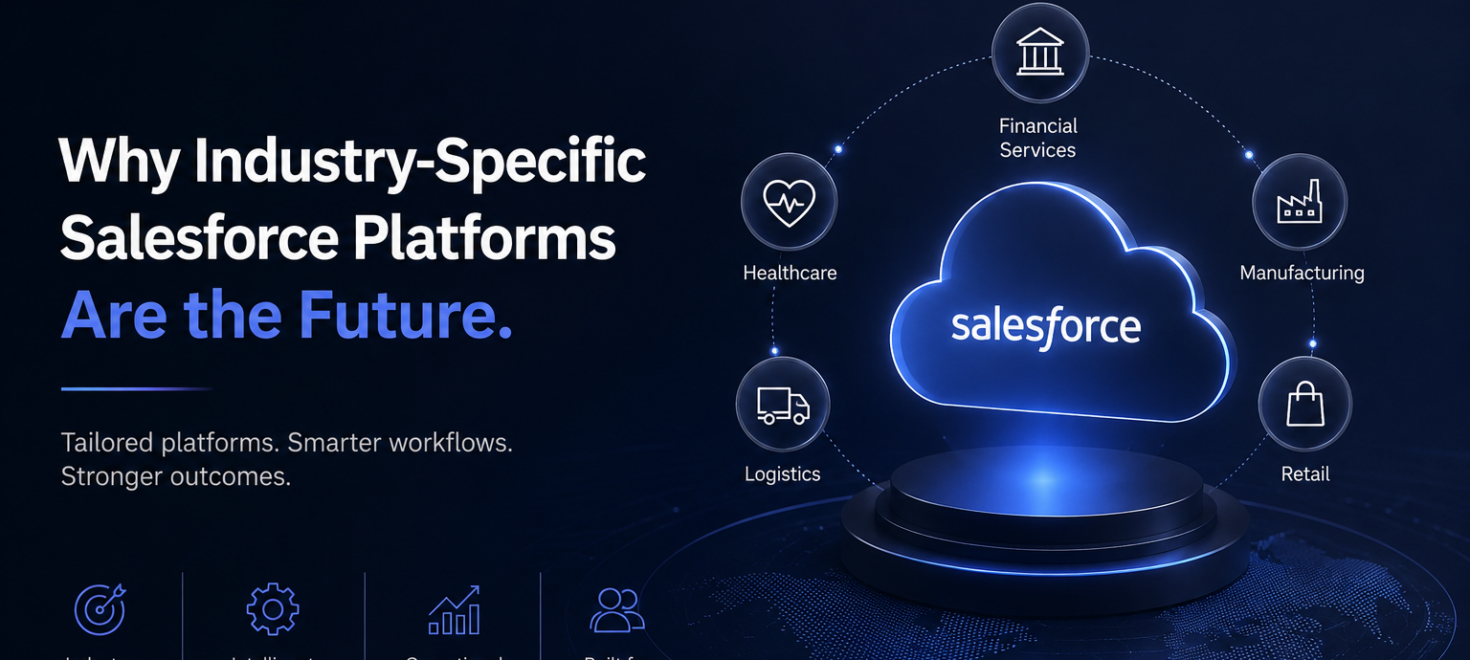
This is why industry-specific Salesforce platforms are rapidly becoming the future of enterprise technology.
At JSBC Labs, we see a major shift happening across the market:
Businesses are moving away from generic CRM implementations and investing in tailored Salesforce ecosystems designed around their unique operational needs.
Because in today’s environment, competitive advantage comes from precision.
The Problem with Generic CRM Implementations
Traditional CRM implementations are often built around broad, standardised functionality.
On paper, this sounds efficient.
But in reality, many businesses quickly discover that generic systems create friction when applied to industry-specific operations.
A manufacturing company does not operate like a healthcare provider.
A logistics business does not manage workflows the way a financial services firm does.
A property platform does not have the same operational needs as a retail organisation.
Yet many businesses still attempt to force highly specialised processes into generic CRM structures.
The result is often:
- inefficient workflows,
- disconnected systems,
- manual workarounds,
- duplicated processes,
- low user adoption,
- and growing operational complexity.
Over time, teams begin relying on spreadsheets, external tools, and fragmented processes to compensate for platform limitations.
The CRM becomes reactive instead of operationally intelligent.
Industry Workflows Require Industry Logic
Modern businesses require platforms that understand their workflows at a deeper level.
Industry-specific Salesforce platforms are designed around the operational realities of a business:
- compliance requirements,
- approval structures,
- reporting needs,
- service delivery models,
- customer journeys,
- and industry regulations.
Instead of adapting operations to fit the platform, the platform is engineered to support the business naturally.
This creates significantly better operational alignment.
For example:
- A healthcare organisation may require patient-driven workflows and compliance controls,
- a logistics company may need real-time operational visibility and automated scheduling,
- while a financial services platform may prioritise auditability, governance, and multi-stage approval processes.
These are not “small customisations.”
They fundamentally shape how the platform should be engineered.
Automation Becomes Far More Powerful
One of the biggest advantages of industry-specific Salesforce platforms is intelligent automation.
Generic automation handles basic tasks.
Industry-specific automation supports real operational outcomes.
When workflows are built around industry logic, businesses can automate:
- approvals,
- onboarding,
- case routing,
- service delivery,
- compliance checks,
- operational escalations,
- reporting,
- customer communication,
- and cross-system processes far more effectively.
This reduces operational overhead while improving speed, consistency, and visibility across the business.
More importantly, automation becomes meaningful – not just functional.
The platform actively supports how the business operates daily.
Operational Efficiency Improves Across the Entire Organisation
Businesses often underestimate how much inefficiency is created by disconnected workflows and generic systems.
Even small operational bottlenecks create cumulative cost:
- slower teams,
- manual intervention,
- reporting inconsistencies,
- delayed decision-making,
- and reduced customer responsiveness.
Industry-specific Salesforce platforms solve this by centralising workflows around the actual business model.
This creates:
- cleaner processes,
- better visibility,
- stronger reporting,
- improved collaboration,
- and significantly higher operational efficiency.
Instead of teams working around the system, the system actively supports productivity.
That distinction matters at scale.
Why Vertical Solutions Outperform Generic Setups
Vertical Salesforce platforms consistently outperform generic implementations because they are engineered with context.
They are designed for:
- specific operational models,
- industry challenges,
- regulatory requirements,
- user behaviour,
- and long-term scalability within a defined environment.
This allows businesses to move faster without sacrificing structure or maintainability.
A properly engineered industry platform provides:
- faster onboarding,
- stronger adoption,
- more accurate reporting,
- lower administrative overhead,
- improved scalability,
- and better long-term ROI.
It also reduces the need for excessive customisation later — because the platform was designed correctly from the start.
The future of Salesforce is not simply broader functionality.
It is smarter, more focused platforms designed around industry realities.
The Role of Proper Salesforce Engineering
Building industry-specific Salesforce platforms requires far more than standard CRM configuration.
It requires:
- architectural planning,
- scalable integration design,
- workflow engineering,
- governance,
- DevOps maturity
- and a deep understanding of operational systems.
At JSBC Labs, we specialise in building Salesforce ecosystems that align technology with real business operations.
Whether through complex implementations, ISV/OEM engineering, or vertical platform development, our focus is always the same:
building Salesforce solutions that scale properly and support long-term business growth.
Because the businesses leading tomorrow will not rely on generic systems.
They will rely on platforms engineered specifically for how they operate today.
Final Thoughts
The era of one-size-fits-all CRM platforms is ending.
Businesses are becoming more operationally specialised, more data-driven, and more dependent on scalable automation than ever before.
Industry-specific Salesforce platforms represent the next evolution of enterprise technology:
systems designed around business reality, not generic functionality.
And as organisations continue prioritising efficiency, scalability, and operational intelligence, vertical Salesforce solutions will increasingly become the standard – not the exception.


