
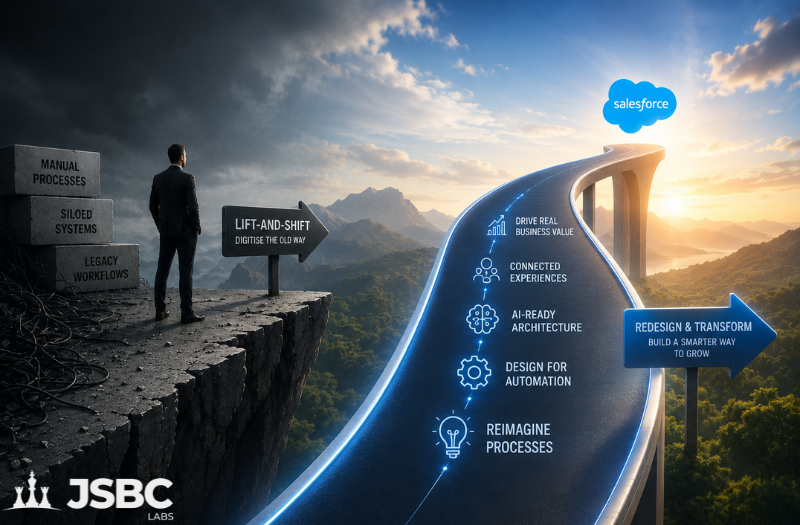
For years, many Salesforce implementations followed the same pattern:
Take existing processes. Move them into Salesforce. Digitise the workflow. Go live.
The problem is that digitising inefficiency does not create transformation.
It simply makes broken processes move faster.
As businesses face increasing pressure to improve operational efficiency, customer experience, and AI readiness, the traditional “lift-and-shift” approach to Salesforce implementation is becoming obsolete.
Modern Salesforce transformation requires something much bigger:
Operational redesign.
The organisations creating the most value from Salesforce today are not simply replicating legacy workflows inside a CRM. They are rethinking how their business should operate entirely.
That shift matters because the demands placed on enterprise systems have changed dramatically.
Businesses now need:
- Connected customer journeys
- Intelligent automation
- Real-time operational visibility
- Scalable workflows
- AI-ready infrastructure
- Faster decision-making across teams
None of those outcomes come from transferring outdated processes into a new platform unchanged.
And yet many implementations still prioritise speed of deployment over quality of transformation.
This often creates long-term problems:
- Overcomplicated workflows
- Poor user adoption
- Process bottlenecks
- Excessive customisation
- Technical debt that limits scalability
In many cases, businesses end up recreating the exact operational challenges they were trying to solve — just inside Salesforce.
At JSBC Labs, we believe Salesforce should challenge inefficiency, not preserve it.
That means approaching implementation strategically:
- Simplifying operational workflows before automation
- Aligning processes with commercial objectives
- Designing scalable architecture from the beginning
- Building with future AI capability in mind
- Creating systems that teams genuinely want to use
The goal is not simply to implement Salesforce.
The goal is to create a smarter operating model.
Because in the next phase of enterprise transformation, the businesses that move fastest will not necessarily be the ones with the most technology. They’ll be the ones with the cleanest operations, the clearest processes, and the most adaptable systems.
That’s where real transformation happens.


